
Godzilla’s Revenge (1969)

Trust me, I don't want to be doing this. This movie is so terribly unwatchable that it hurts just to look at the DVD cover. The only reason I'm even trying is that I want to have a complete Godzilla review section one day and that means I'm going to eventually have to do it. But you don't want to read this any more than I want to write it, so I'll make it quick. Most of my reviews are in-depth and scene by scene, stretching to twenty pages or more. I cannot conceivably write even a tenth of that for this dreck, so I will try and paraphrase as much as possible.
Our movie first opened in Japan on December 20, 1969 under the title All Monsters Attack with a thankfully brief running time of 70 minutes. This was deliberately set out be a Godzilla film aimed at small children for release during the Christmas season, and it succeeded in making a profit as such. In 1971, it was picked up by American distributor UPA and released over here under the title of Godzilla's Revenge, with a 69 minute run time (the UPA version differed only in the opening credits and the soundtrack). In 2002, it was re-released on DVD by Sony Classic Media and this is the version I'll review here.
Ok, here goes...
This film is about the life of a young boy named Ichiro Miki (played by unknown child actor Tomonori Yazaki, though the dubbed English voice is oh so obviously an adult squeaking like a child). [Editor Pam: The little girl who walks home from school with him also seems to be dubbed by an adult trying to sound like a child, and not doing too well at it.] Ichiro is about ten-years old and kind of an anti-social runt. Throughout the whole movie Ichiro wears these frighteningly short gray micro-shorts. We're talking Daisy Duke short, roller derby queen short, John Stockton of the Utah Jazz short.

Ichiro.
It's this eye-burning image of little boys in mini-shorts that have given the 1960s Godzilla movies such a bad name. in fact, all the little boys in this film sport the micro-shorts and the few girls that we see are wearing tiny little miniskirts. I realize that this is a different culture, but the sight of ten-year old girls in miniskirts that barely cover their butt cheeks seems a little perverted, even for the 1960s. Anybody who thinks that elementary school kids today are dressing too suggestively should watch this movie.
Ichiro lives in Kawasaki, a grimy, nasty, over-polluted district of Tokyo. Kawasaki is like Pittsburgh in the 1930s, like Toledo in the 1950s, like South Philadelphia today. This is not a healthy environment for raising children. Ichiro is a latchkey kid, his mother works long hours late into the day at an office and his father is a train engineer who works a lot of overtime. As such, Ichiro, who's an only child, spends a lot of his life alone with his dreams and imagination.

Kawasaki.
He's watched over by his neighbor, a friend of the family and a self-employed toy builder named Shinpei Inami. Shinpei is played by 43-year old Eisei Amamoto, one of Japan's most distinctive character actors who has appeared in much better films than this one. Amamoto was normally in other films as the slimiest of criminals, gangsters and henchmen, so his role here as friend to Ichiro is refreshingly different. He is, however, a scary looking man with an Amish beard and greasy hair and if I would have to pick a child molester out of a lineup he was in, I'd be hard pressed to find another candidate.

Shinpei.
Ichiro, being a runt with no friends and social skills, is the target of bullies. His main tormentor is a big boy named Gabara (who wears an "Indianapolis 500" t-shirt the entire movie). Usually, Gabara just taunts him and takes his stuff, Ichiro runs away and hides. The story centers on Ichiro's desires to find a way to stand up to this bully without getting his ass handed to him. In this timeline, all the pantheon of Toho's monsters live on Monster Island, and Ichiro is fascinated with these creatures as all young boys would be. It's to Monster Island that his daydreams of escape take him. To this end he goes into his fantasy world where he hangs out with Minya son of Godzilla, who is being tormented by his own Gabara. Together, Ichiro and Minya learn from each other how to fight back and defeat their bullies. [Editor Pam: The more I look at Minya, the less resemblance I see to him and Godzilla. The shape of their heads, their skin, their teeth, their dorsal fins -- I just don't see how Minya can grow up to look like Godzilla. Was Mrs. Godzilla perhaps fooling around? I wonder what the Godzillas' milkman looks like?]

The "gang".
Mostly, Ichiro's role in the monster scenes is one of hiding behind rocks watching the stock footage Godzilla beat up on various stock footage monsters. I'm not going to give you any blow-by-blow accounts of the various fights as they are clearly not happening in real life. All of the monster scenes in this movie are dream sequences and cannot be taken as canon when studying the history of the monsters. The best I'll give you is a list of the monsters seen in these dream sequences.
We see Godzilla, of course, Mothra the mutant butterfly, Ebirah the mutant shrimp, Angilius the mutant ankylosaurus, Gorosaurus the mutant therapod, Kamacuras the mutant mantis, Kumonga the mutant spider, Ookondru the mutant condor, Manda the mutant snake, and Minya the son of Godzilla. Minya here has shrunk down to human child-size to better relate with Ichiro and even speaks Japanese! Kill me! [Editor Pam: Minya and Ichiro meet cute -- Ichiro falls into a hole at least 30 feet deep, landing unhurt and with his cap still on his head, and Minya lowers a vine to him and pulls him out. Minya has a cartoon-ish voice I know I've heard before, but I can't remember the name of the actor. He doesn't look too good in his closeups, his face doesn't change expression and he moves very stiffly. His mouth barely moves when he talks, and later when he fights Gabara, he keeps that open-mouthed semi-smile he's always had.]

Why, oh why?
Because of cost-saving concerns, nearly 80% of the monster footage is stock ripped from numerous Godzilla movies. Most of the footage is from 1966's Godzilla versus the Sea Monster and 1967's Son of Godzilla, with some smaller snippets from 1967's King Kong Escapes and 1968's Destroy all Monsters. All this footage from movies less than three years old must have been glaringly obvious to Japanese audiences in 1969, but apparently no one cared. This is a kids' movie, after all, and kids don't mind seeing the same stuff over and over (and over and over and over...).
There is some new monster footage shot for Godzilla's Revenge, however, and it's fairly well-done and effective. The only new monster added for this movie is Gabara, a biped monster which symbolically represents the bully of the same name that picks on Ichiro. Gabara is a figment of Ichiro's imagination and deserves little explanation or exploration of his morphology or actions.
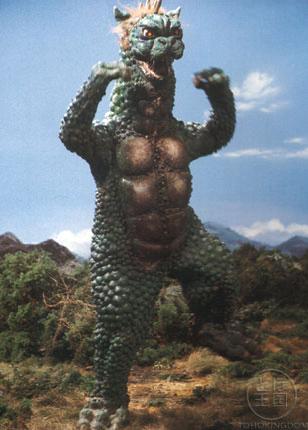
Gabara!
Toho's special effects master Eiji Tsuburaya was bedridden during production, so director Ishiro Honda took over the effects direction. Honda wasn't too keen on special effects, which explains the copious use of stock footage. Tsuburaya was credited out of respect and has unfairly been pounded for this movie. [Editor Pam: At this point in the movie, Minya and Gabara fight, and I can't resist describing it, because it's kind of weird. The actions don't make all that much sense, but since it's supposed to be Ichiro's dream, I guess that's reasonable. Minya suddenly grows a lot bigger, apparently just by wishing, then he attacks Gabara. However, Minya runs away after a minute or so, shrinking back to Ichiro-size as he does, and I can't blame him, because Gabara is still about twice his size and can generate electricity, which he directs into his opponents. All in all, he's an awful lot for a little guy like Minya to fight, and Minya seems discouraged. Then we switch to Godzilla senior as jets suddenly attack him for no apparent reason, but he doesn't panic, he smashes them all and sits down in satisfaction. By the way, you can see the zipper on the Godzilla suit very plainly in this scene. Godzilla seems to be telling Minya to go back to Gabara and fight like a monster, although it seems odd that Godzilla speaks to Minya in Godzilla roars and Minya answers in English. However, Godzilla is not sending Minya back unprepared. He teaches Minya how to emit some serious flame by stepping on Minya's tail, causing Minya to yelp and shoot forth a respectable jet of blue fire. Minya claps his hands, or paws, in glee, and…Ichiro is abruptly grabbed by the bank robbers and wakes up. Later the movie switches back to Minya, and we see him overcome Gabara, although it's by using a rock balanced like a seesaw, not by breathing fire. At this point Gabara makes the mistake of attacking Dad, who beats him up good but has to expend a fair amount of effort to do it. It seems unreasonable to expect Minya to take on something that now appears to be an adult, not a child bully about his own age, but perhaps Godzilla has very high expectations for his son. And maybe this whole Minya-Gabara fight is intended to make Ichiro's problem with Gabara look less serious?]
The sidebar plotline revolves around two bumbling bank robbers named Senbayasi and Okuda who kidnap Ichiro when he stumbles across their hiding place. These two thieves are played so comically as to be totally non-threatening to kiddy audiences and are little more than cartoon characters. Bank Robber Senbayashi is played by Sachio Sakai (best known for being Mister Tako's assistant Obayashi from 1962's King Kong versus Godzilla) and Bank Robber Okuda is played by 32-year old Kazuo Suzuki (who did little save a bit role in 1975's Terror of MechaGodzilla).

The robbers.
Two police detectives are out hunting the crooks. The Head Detective is played by 51-year old Yoshifumi Tajima (famous for being the delightfully villainous entrepreneur Kumayama in 1964's Godzilla versus Mothra I) and the Assistant Detective is played by 28-year old Chotaro Togin (infamous for being the clueless Ichiro from 1966's Godzilla versus the Sea Monster). The bank robbers are supposed to have stolen "50 million yen" from a bank, which seems like a huge amount of money even for 1969 standards. Other than these two detectives going door to door, there doesn't seem to be much rush on the part of the police to find these two robbers.

The cops.
Learning tenacity and courage from his daydreams with Minya, Ichiro escapes the robbers and hides from them in an abandoned warehouse. In a sequence reeking of Home Alone, Ichiro sets improbable and impromptu booby traps to avoid capture.

I hated this movie.
Eventually the police arrive and the robbers are finally arrested. Emboldened by his exploits against the robbers, Ichiro then has the courage to stand down his bully Gabara and wins the trust of the gang of kids that has been harassing him. As the movie ends, Ichiro runs off with these hooligans, knocking over paint cans and laughing happily. We're supposed to feel uplifted by Ichiro's coming-of-age triumph and courage under pressure, but we can't help but notice that his situation hasn't really changed all that much. He still never sees his parents, he still lives in a hell-hole city, still has very little future, the only real change is that now he has a pack of punk kids to run around with. I can't see how this is really an improvement over his previous life. Any chance of him rising out of his situation is now hampered by the cliqueish constraints of gang life, from which he will be unlikely to escape. I guess the moral of the story is that violence is the way to solve your problems. I see him in jail for boosting a Toyota by age 17, and dead from a knife fight in a bar by 22. [Editor Pam: He's already on his way. After he beats up the bully, he honks the horn on a nearby motorcycle, causing a man who's painting a billboard to fall off his ladder and spill paint all over his face. This seems to be considered a fine piece of humor on Ichiro's part. At least the other kids think so, although the man isn't laughing. He fell far enough so that he's lucky he didn't get hurt.]
The highlight of this movie is the strong acting performances by Ichiro's parents, who are especially well-presented. His mother (who we never learn a name for) is played by Machiko Naka, whose career has mostly consisted of bit roles in Toho's popular Young Guy series of comedies. Ichiro's father Kenkichi "Tack" Miki is played by 37-year old Kenji Sahara, one of the great actors of our time and a Godzilla legend. They both do excellent jobs of presenting us with caring parents put in a terrible situation by unfavorable economic pressures. It's a shame their roles are not larger.


Mom and Dad.
That's all I'm going to say about this movie. It really should have never been a Godzilla movie to begin with. It's more of a ABC After-School Special that just happens to have some monsters in it.
BTW, I looked real hard, but I didn't see where Godzilla got his "revenge". I guess the American distributor who renamed this film just thought it sounded cool.
Bonus! A few stats for you:
3: Number of cigarettes smoked by our cast.
1: Number of costume changes by Ichiro the entire movie.
[Editor Pam: Definitely a movie made to appeal to small children, not adults, who probably won't be able to sit through it easily. Even as a movie for children, though, I don't really like it. There are parts that don't work, like the unsavory-looking toy developer, and the fact that as soon as Ichiro defeats the bully, the first thing he does is bully someone else. However, it's possible there's more to this bullying than first meets the eye. The guy who falls off the ladder is wearing a cowboy hat, and I think a gun in a holster, although this seems impossible in Japan. It might be a toy gun, but it seems weird for an adult to carry a toy. Could this have been intended as a subtle dig at the United States, which is why all the movie characters think it's so funny?]
Written in June 2004 by Nathan Decker.
comments powered by Disqus
that's between you and the vengeful wrath of your personal god...